
Anatomy of an Australian Breach: Why Automated Vulnerability Scanners Miss Real Business Logic
Australian mid-market cybercrime costs surged 45% to $141,300 (ASD). Learn how attackers chain API, session, and perimeter flaws scanners miss—and how manual pentesting stops them.
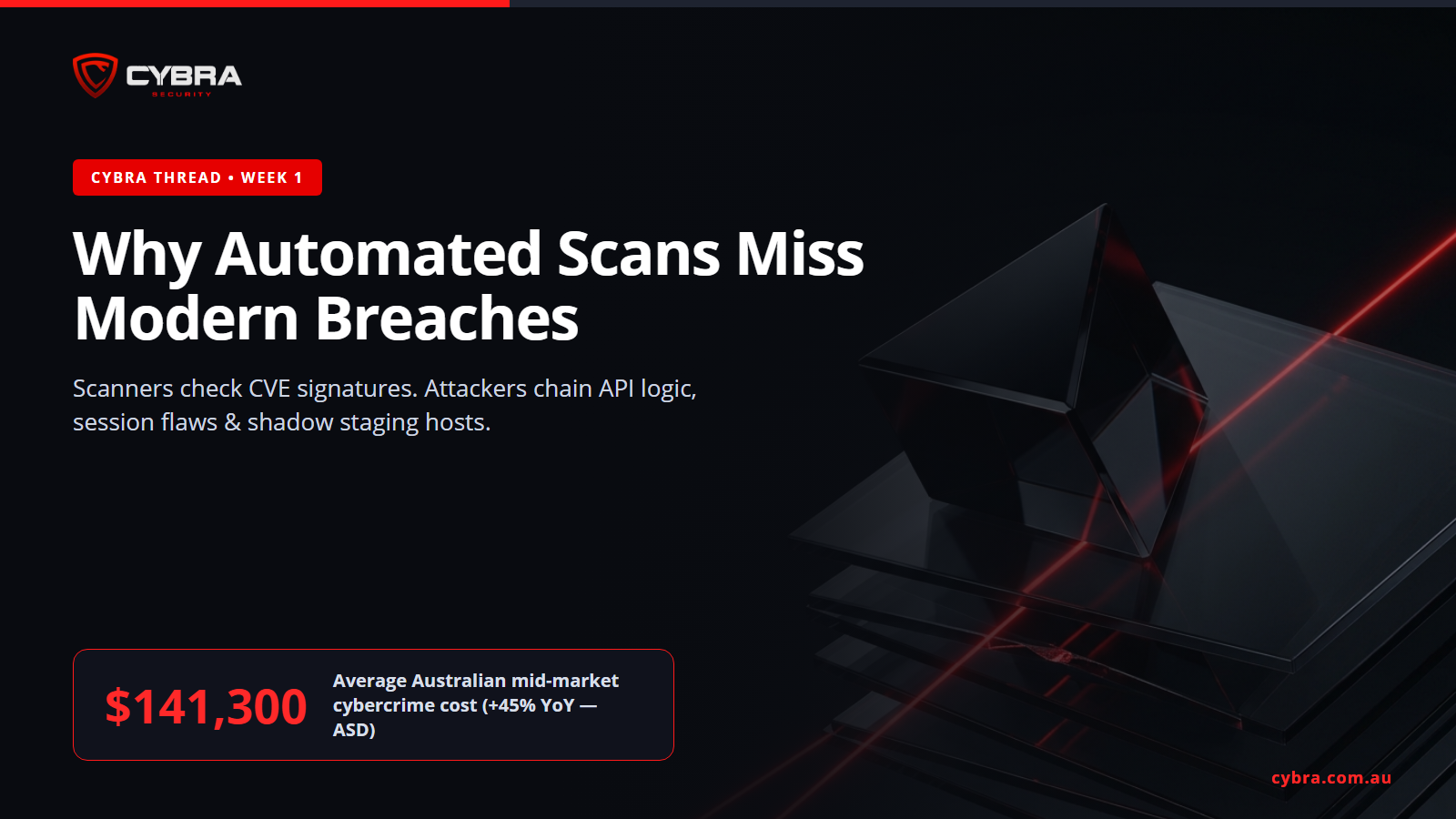
The average self-reported cost of cybercrime for a medium-sized Australian business surged 45% in a single year—reaching $141,300 per report, according to the Australian Signals Directorate (ASD) Annual Cyber Threat Report.
That figure puts mid-market Australian organisations within $7,000 of the average financial impact absorbed by large enterprises ($148,100), despite operating with a fraction of the internal security headcount. Across the country, the ASD now receives roughly one cybercrime report every six minutes—surpassing 84,000 reports annually—while the ACSC responds to more than 1,500 targeted incidents each year.
Yet when Cybra Security conducts external and web application penetration tests for Australian organisations, we hear the same line almost every week before testing begins:
"We run automated vulnerability scans every month, and our reports come back clean."
Here is the uncomfortable reality: automated scanners check known signatures, while real attackers exploit chained business logic.
How Modern Australian Breaches Actually Unfold
Very few mid-market breaches rely on exotic nation-state zero-days. Instead, adversaries—increasingly accelerated by AI reconnaissance that probes newly disclosed flaws within hours—chain together three or four quiet exposures that no signature scanner understands in combination:
Why a "Green" Automated Scan Creates False Confidence
Automated vulnerability scanners have a valuable place in continuous hygiene: they catch missing software patches, expired TLS certificates, and obvious misconfigurations rapidly.
What they fundamentally cannot do is reason like an experienced human tester operating inside your application:
Four Controls That Break 80% of Real Web & API Attack Chains
Before your next major release or annual assessment, focus your engineering effort on four concrete controls that collapse real-world attack paths:
Test How Attackers Actually Break In
At Cybra Security, our CREST-accredited and OSCP-certified Australian testers conduct tailored Web Application, API, External Perimeter, Cloud, and Active Directory penetration tests aligned with OWASP and PTES across Melbourne, Sydney, Brisbane, Perth, Adelaide, Darwin, and Tasmania.
Every engagement delivers verified, reproducible proof of exploitability, a concise 1-page board-ready executive summary, and clear engineering remediation steps—zero automated scanner dumps.
Skip the 45-minute discovery call. Use our 60-second interactive estimator for an instant consulting effort range, tailored Cybra methodology, and pre-test readiness checklist—or grab our 2026–27 Pre-Pentest Readiness Guide.