
CYBRA SECURITY BLOG • 3 MIN READ

The 2027 Australian Boardroom Cyber Brief: 5 Questions Every Director Must Ask Now

OAIC mega-breaches jumped from 4 to 11 in H1 2026, the Statutory Privacy Tort is live, and APP 1.3 starts Dec 2026. Five blunt questions Australian boards must ask for 2027.
By Cybra Security Offensive Team • CREST & OSCP Certified Specialists • Australia-Wide
The 2027 Australian Boardroom Cyber Brief: 5 Questions Every Director Must Ask Now

Cybersecurity in Australia has crossed permanently from an IT operational cost into a direct boardroom legal and fiduciary issue.

If you are sitting on an Australian board, audit committee, or executive leadership team setting 2027 budgets, two official datasets and two legislative milestones define the reality heading into the new year.

The Verified Australian Breach Reality (2025 – H1 2026)

Data published by the Office of the Australian Information Commissioner (OAIC) under the Notifiable Data Breaches (NDB) scheme reveals that while reporting volume sits at record highs, the blast radius of individual breaches is escalating sharply:

■
1,205 data breach notifications in 2025—an 8% increase over 2024 and the highest annual total since the scheme launched in 2018.
■
667 notifications in the first six months of 2026 alone (January–June 2026).
■
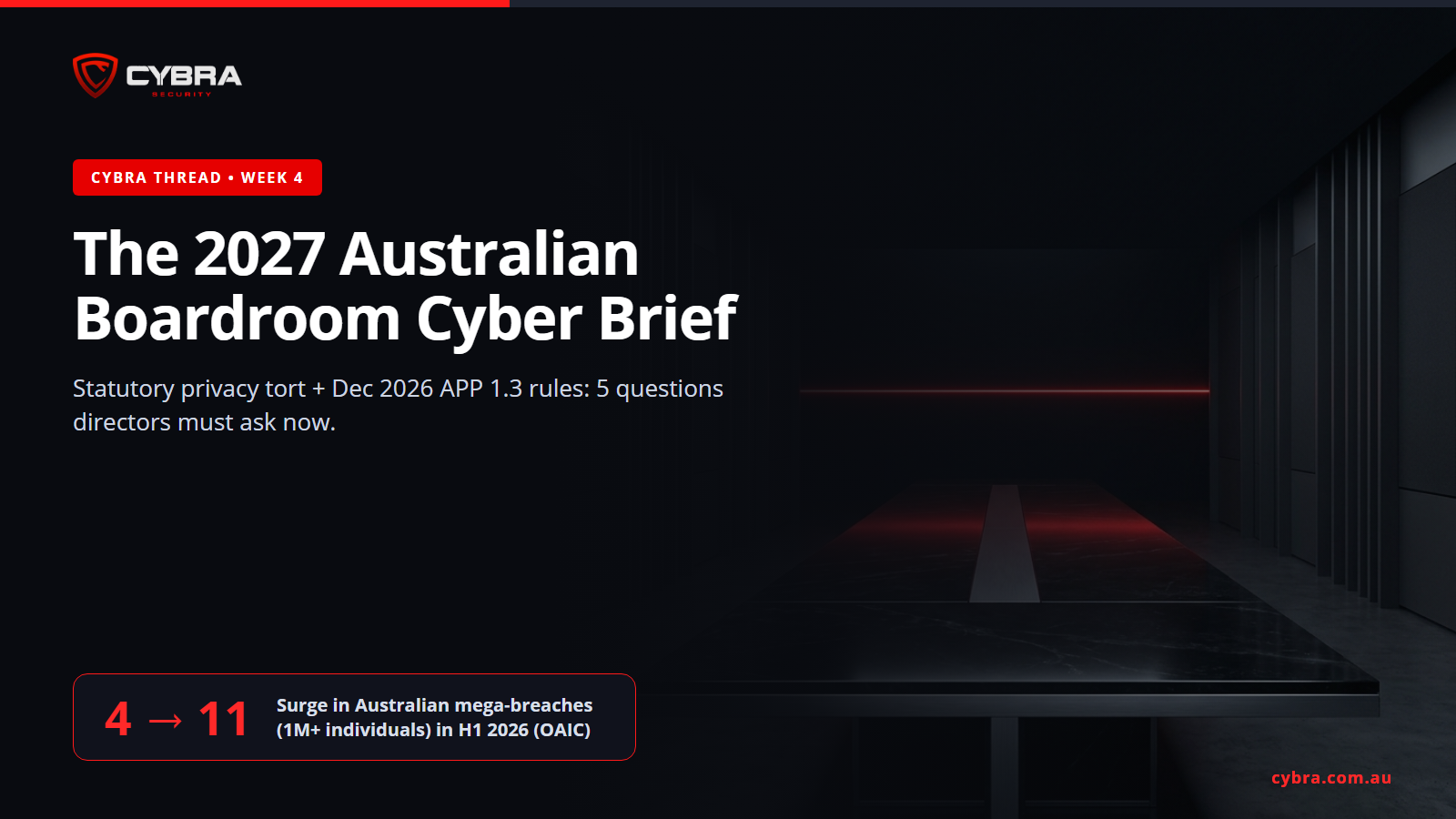
Mega-breaches affecting 1 million+ individuals surged from 4 to 11 in H1 2026—while breaches impacting 100,000 to 250,000 Australians doubled from 3 to 6.
■
59% to 70% of all reportable breaches stem from malicious or criminal attacks (phishing, compromised credentials, ransomware, and direct hacking), with health services (19%), education, professional associations, financial services, and legal/accounting firms most heavily impacted.

Meanwhile, the Australian Signals Directorate (ASD) confirms average cybercrime costs for medium-sized businesses surged 45% to $141,300 per report.

Why Legal Exposure Under the Privacy Act Just Changed

Under Australian Privacy Principle (APP) 11, organisations have long been required to take reasonable steps to protect personal information from misuse, interference, loss, and unauthorised access or disclosure. Across 2025 and 2026, enforcement teeth tightened substantially:

■
Statutory Tort for Serious Invasions of Privacy (Effective June 2025): Individuals now hold a direct statutory avenue to sue organisations in civil court over serious privacy violations or reckless mishandling of personal data.
■
APP 1.3 Automated Decision-Making Transparency (Effective December 2026): Organisations must explicitly disclose when computer programs or AI systems use personal information to make decisions that significantly affect individuals—placing underlying customer databases and APIs under sharper scrutiny.
■
Tranche 2 Privacy Reforms (2026 Exposure Bill): Moves Australia toward a baseline "Fair and Reasonable" data-handling test and Right to Erasure, raising expectations around data minimisation and demonstrable security hygiene.

5 Blunt Questions Every Australian Director Should Ask for 2027

You do not need to read raw CVE logs to govern cyber risk effectively. Put these five plain-English questions in front of your technology and security leaders before signing off next year's roadmap:

1
Could an external attacker extract customer personal information today—triggering an OAIC NDB notice? Ask for verified proof from manual testing, not assumptions.
2
Does our testing scope include forgotten staging portals, cloud IAM, and internal Active Directory—or only our public homepage? Breaches overwhelmingly start on unmonitored side doors and escalate inside Active Directory.
3
Are we commissioning genuine manual penetration tests by CREST/OSCP-calibre testers, or paying for automated scans wrapped in a nice PDF cover?
4
Can our engineering team realistically meet ACSC's 48-hour critical patching ceiling under pressure?
5
Do our penetration test reports include a concise 1-page Executive Summary we can actually read and fund? If a report buries leadership in 90 pages of raw scanner jargon, demand better reporting.

Structuring a Practical 2027 Offensive Security Cadence

Stop booking penetration tests two weeks before an ISO 27001, PCI DSS, or cyber insurance renewal deadline—leaving zero breathing room to fix real issues cleanly. High-performing Australian teams spread validation cleanly across the year:

■
Q1: External Perimeter, Cloud & Flagship Web App / API Penetration Test
■
Q2: Internal Active Directory & Privilege Escalation Assessment
■
Q3: Controlled Red Team, AI-Era Phishing Simulation & Physical Security Validation
■
Q4: Secure Code / Config Review & Formal Retesting Ahead of Year-End Audits

Bridge the Server Room and the Boardroom

At Cybra Security, every penetration test combines senior CREST and OSCP technical rigour with a crisp, 1-page board-ready executive summary—giving directors clear risk visibility and engineers exact, reproducible fixes.

CYBRA SECURITY • CREST & OSCP AUSTRALIAN PENTESTING
Ready to See What a Manual Penetration Test Would Actually Uncover?

Skip the 45-minute discovery call. Use our 60-second interactive estimator for an instant consulting effort range, tailored Cybra methodology, and pre-test readiness checklist—or grab our 2026–27 Pre-Pentest Readiness Guide.

Categories:

Tags:

Book a free Cyber Security consultation today