
CYBRA SECURITY BLOG • 4 MIN READ

Anatomy of an Australian Breach: Why Automated Vulnerability Scanners Miss Real Business Logic

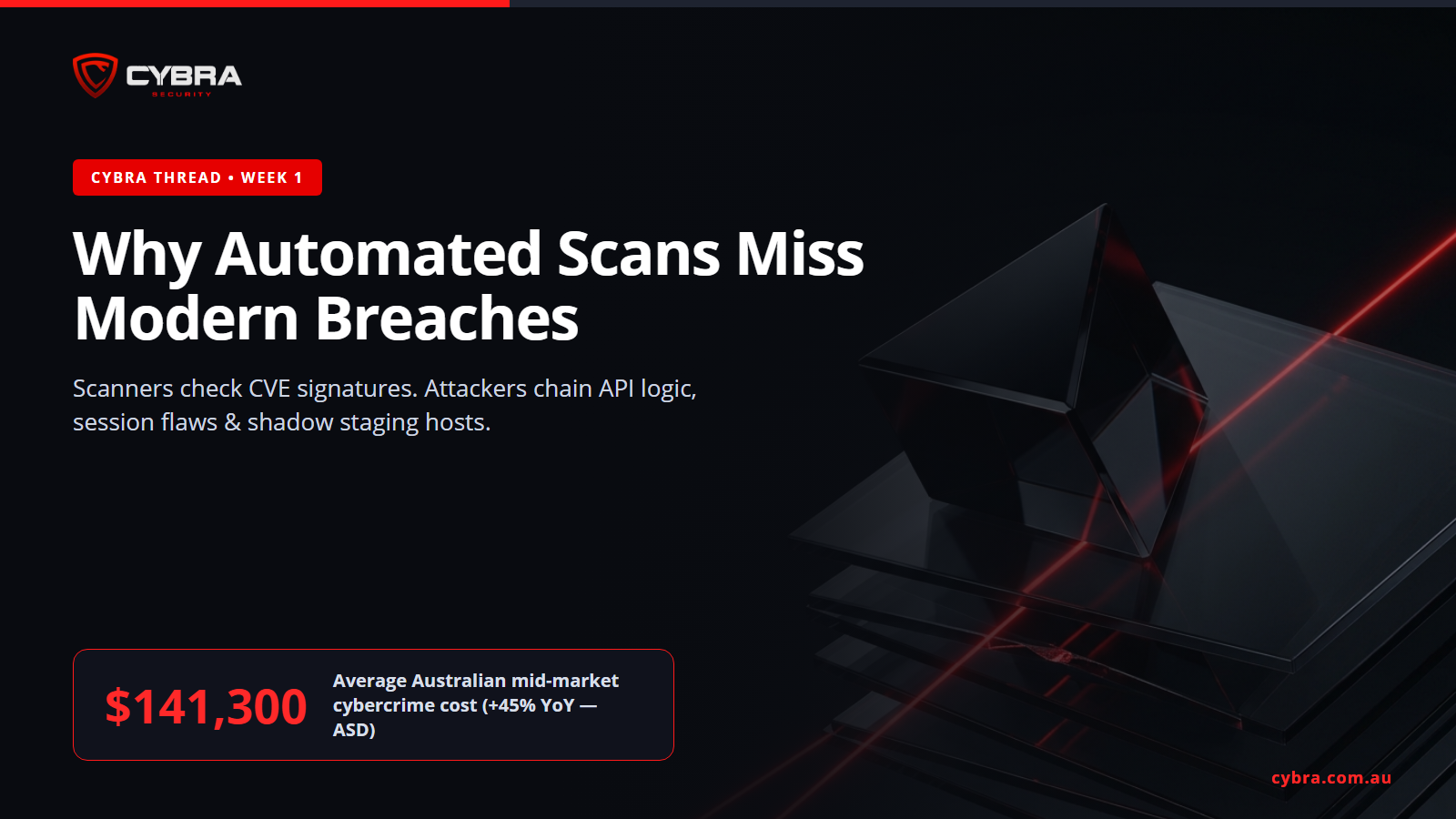
Australian mid-market cybercrime costs surged 45% to $141,300 (ASD). Learn how attackers chain API, session, and perimeter flaws scanners miss—and how manual pentesting stops them.
By Cybra Security Offensive Team • CREST & OSCP Certified Specialists • Australia-Wide
Anatomy of an Australian Breach: Why Automated Vulnerability Scanners Miss Real Business Logic

The average self-reported cost of cybercrime for a medium-sized Australian business surged 45% in a single year—reaching $141,300 per report, according to the Australian Signals Directorate (ASD) Annual Cyber Threat Report.

That figure puts mid-market Australian organisations within $7,000 of the average financial impact absorbed by large enterprises ($148,100), despite operating with a fraction of the internal security headcount. Across the country, the ASD now receives roughly one cybercrime report every six minutes—surpassing 84,000 reports annually—while the ACSC responds to more than 1,500 targeted incidents each year.

Yet when Cybra Security conducts external and web application penetration tests for Australian organisations, we hear the same line almost every week before testing begins:

"We run automated vulnerability scans every month, and our reports come back clean."

Here is the uncomfortable reality: automated scanners check known signatures, while real attackers exploit chained business logic.

How Modern Australian Breaches Actually Unfold

Very few mid-market breaches rely on exotic nation-state zero-days. Instead, adversaries—increasingly accelerated by AI reconnaissance that probes newly disclosed flaws within hours—chain together three or four quiet exposures that no signature scanner understands in combination:

1
Automated External Reconnaissance: Within hours of a new software deployment or certificate renewal, automated scanners sweep Australian IP space and public Certificate Transparency logs to discover forgotten staging portals, exposed databases, and non-WAF cloud endpoints.
2
An Over-Sharing API or Logic Flaw (IDOR): A customer portal masks an email address on screen (***@example.org.au) while returning the target user's unmasked full name, membership status, or internal identifier in the raw HTTP JSON response. By incrementing sequential IDs from a single logged-in account, an attacker harvests thousands of customer records.
3
Credential Reuse & Broken Session Handling: According to the ASD, compromised credentials remain one of the primary breach vectors in Australia. When a portal allows optional Multi-Factor Authentication (MFA), accepts weak passwords without breach-list screening, or fails to invalidate session tokens server-side upon logout, stolen credentials translate straight into persistent account takeover.
4
Data Exfiltration & Regulatory Impact: Once customer personal information is extracted, the incident shifts immediately from an IT ticket to a board-level crisis under Australian Privacy Principle (APP) 11 and the OAIC Notifiable Data Breaches (NDB) scheme.

Why a "Green" Automated Scan Creates False Confidence

Automated vulnerability scanners have a valuable place in continuous hygiene: they catch missing software patches, expired TLS certificates, and obvious misconfigurations rapidly.

What they fundamentally cannot do is reason like an experienced human tester operating inside your application:

■
Scanners cannot judge authorisation intent. An endpoint returning HTTP 200 OK with another customer's unmasked name looks completely healthy to an automated tool. Only a human tester inspects the raw wire traffic across two test accounts to confirm Insecure Direct Object Reference (IDOR).
■
Scanners cannot verify server-side logout. Clicking Sign Out in a browser clears the local cookie—making everything look secure on the surface—while leaving the session token accepted by the server for hours.
■
Scanners cannot trace downstream impact. Unvalidated profile fields might safely HTML-encode inside the web page while triggering formatting corruption or injection issues inside automated PDF invoices, CRM syncs, or marketing emails.
■
Scanner dumps exhaust engineering teams. Commodity vendors often export 90-page PDFs padded with theoretical CVEs and third-party letter grades, burying the two genuinely exploitable flaws in a mountain of noise.

Four Controls That Break 80% of Real Web & API Attack Chains

Before your next major release or annual assessment, focus your engineering effort on four concrete controls that collapse real-world attack paths:

■
Eliminate direct-to-internet databases and admin ports: Bind databases and management interfaces strictly to private networks behind VPN or zero-trust access, enforcing mandatory authentication and TLS.
■
Enforce server-side object authorisation and field masking: Never trust the frontend UI to hide sensitive fields. Strip unneeded attributes at the API layer and enforce per-session rate limiting independent of your CDN.
■
Kill sessions server-side and mandate MFA: Revoke session tokens in your backend store immediately on logout, enforce idle timeouts, block known-breached passwords on reset, and transition away from optional MFA.
■
Lock down staging, UAT, and stale DNS: Put every non-production portal behind corporate IP allow-lists or VPN, keep customer data out of test environments, and retire dangling DNS records immediately.

Test How Attackers Actually Break In

At Cybra Security, our CREST-accredited and OSCP-certified Australian testers conduct tailored Web Application, API, External Perimeter, Cloud, and Active Directory penetration tests aligned with OWASP and PTES across Melbourne, Sydney, Brisbane, Perth, Adelaide, Darwin, and Tasmania.

Every engagement delivers verified, reproducible proof of exploitability, a concise 1-page board-ready executive summary, and clear engineering remediation steps—zero automated scanner dumps.

CYBRA SECURITY • CREST & OSCP AUSTRALIAN PENTESTING
Ready to See What a Manual Penetration Test Would Actually Uncover?

Skip the 45-minute discovery call. Use our 60-second interactive estimator for an instant consulting effort range, tailored Cybra methodology, and pre-test readiness checklist—or grab our 2026–27 Pre-Pentest Readiness Guide.

Categories:

Tags:

Book a free Cyber Security consultation today